Custom Bowling Shirts for Car Clubs: 2026 Guide

Table of Contents
- Why Custom Bowling Shirts Fit Car Club Culture
- Vintage Style Work Shirts for Car Clubs That Handle the Garage
- Custom Embroidered Bowling Shirts: Logo Placement and Design
- Bulk Custom Apparel for Car Clubs: Pricing and Turnaround
- Fabric and Fit: What Car Club Members Should Know
- Caring for Your Custom Club Shirts
- Frequently Asked Questions
Last Updated: September 11, 2026
Why Custom Bowling Shirts Fit Car Club Culture
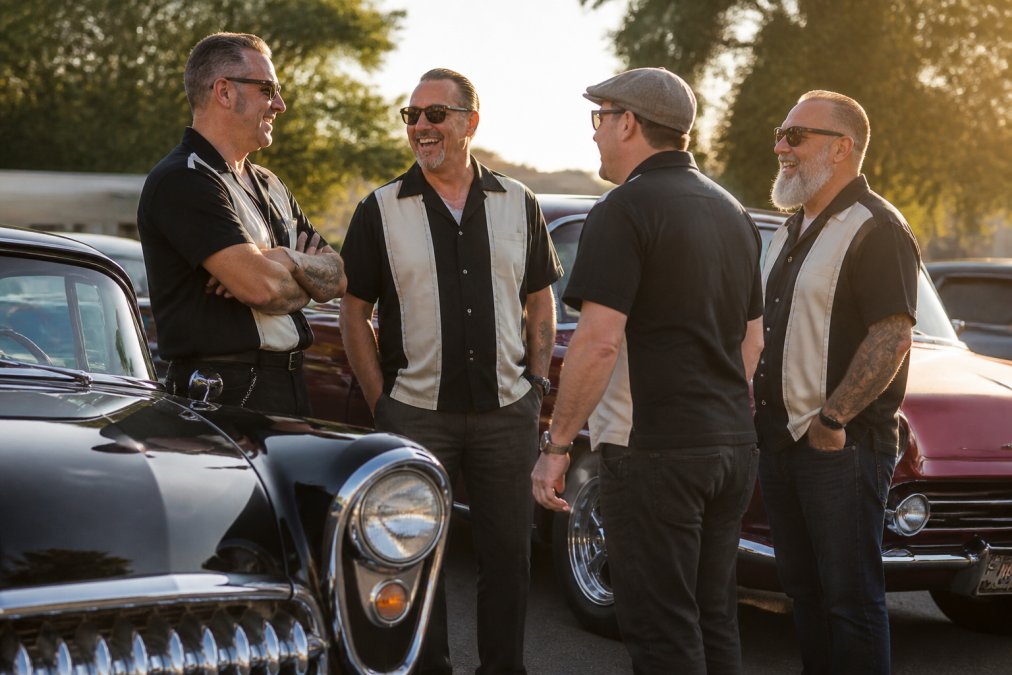
Custom bowling shirts for car clubs solve a problem most gearheads run into the moment they try to look like a real club instead of a group of strangers who happen to park together. The retro bowling shirt, with its boxy cut, contrast panels, and bold embroidery, sits at the exact intersection of mid-century Americana and garage culture. The retro bowling shirt, with its boxy cut, contrast panels, and bold embroidery, sits at the exact intersection of mid-century Americana and garage culture. The bowling shirt is the natural home for team logo embroidery and personalized jerseys.

The reason is simple: it's the shirt that 1950s hot rodders and drag racers already wore. A vintage style button-up reads as authentic in a way a modern performance polo never will.
Vintage Style Work Shirts for Car Clubs That Handle the Garage
Vintage style work shirts for car clubs have to survive more than a photo shoot. Members will wear them to swap meets, cruise nights, and actual wrench sessions, so the fabric has to handle grease, oil, and repeated washing without falling apart.
This is where most retro apparel fails. A shirt that looks perfect in a product photo often uses thin fabric that pills after three washes. The fix is to look for a polyester-cotton blend or a durable 100% polyester weave, both of which resist staining and hold their color (textileexchange.org). Steady Clothing's Built For Speed Workshirt, for example, uses a 65% polyester, 35% cotton blend that's built for shop work and printed with garage-inspired graphics. It costs $67.99 and comes in black or navy.

For clubs that want a softer, more classic look, the Revel in Rust Workshirt in Black at $67.99 offers the same construction with a grey garage print.
Custom Embroidered Bowling Shirts: Logo Placement and Design
Custom embroidered bowling shirts live or die on two decisions: where the logo goes and how the thread is stitched. Get those right and a club looks sharp. Get them wrong and you've spent money on a shirt nobody wants to wear.
The classic layout is a left-chest club crest with the club name arched across the back yoke. A second, smaller placement on the left sleeve works well for event or sponsor patches. Keep the front chest logo under about 4 inches wide so it doesn't fight with the shirt's panel stitching.
Choosing Thread Colors and Stitch Styles
Thread color should contrast with the shirt body but stay within the club's palette. On a black body, a cream or gold thread reads clearly; on a red panel, a white or black thread holds up better. For stitch style, a flat fill works for solid shapes and block lettering, while a satin stitch gives small text and fine borders a cleaner edge. Avoid overly detailed artwork at small sizes, because fine lines blur together once stitched.
For clubs that want full-color graphics rather than thread, sublimation printing allows detailed, photographic designs that embroidery can't reproduce. The trade-off is that sublimation sits on the fabric surface, while embroidery adds texture and depth that reads as more premium up close.
Bulk Custom Apparel for Car Clubs: Pricing and Turnaround
Bulk pricing for car club shirts is not a single number, it's the blank cost plus the decoration cost, and the decoration method you choose changes both the price and how long the shirt lasts. Understanding the three main methods lets a club treasurer build an accurate budget instead of guessing.
Embroidery vs. Screen Printing vs. Sublimation: How to Choose
Embroidery stitches thread directly into the fabric. It's the classic choice for a club crest, a name arched across the back yoke, or a sponsor patch, and it's the most durable option, thread outlasts the shirt in most cases. The limits are detail and color: fine lines blur at small sizes, and each additional thread color adds setup and run time. Embroidery is the right call for a left-chest logo, a back-yoke club name, and sleeve patches.
Screen printing lays ink through a mesh screen onto the fabric surface. It's cost-effective at higher quantities and handles bold, flat-color graphics well, but each color requires its own screen, so multi-color designs get expensive fast. Ink sits on top of the fabric and can crack or fade with heavy washing, which makes it a weaker choice for a shirt that sees garage duty.
Sublimation dyes the fabric itself using heat and pressure, so the design becomes part of the material rather than a layer on top. It's the only method that reproduces full-color, photographic, or gradient artwork, flames with shading, detailed pinstriping, or a club photo, and it never cracks or peels because there's nothing to peel. The catch is that sublimation works best on light-colored 100% polyester, because the dye bonds with polyester fibers and light backgrounds let the colors read true. On dark shirts, sublimation requires a white underlayer or a different approach.
A practical rule for car clubs: embroider the crest and club name, sublimate any large full-color back graphic, and consider alternatives to screen printing on shirts that will be worn in the shop.
What Drives Your Per-Shirt Cost
Four variables set the final number:
- Blank cost. A basic poplin bowling shirt starts lower than a wide-panel popcheck style. Steady Clothing's Poplin Double Panel Bowling Shirt in Black/Red and Poplin Wide Panel Bowling Shirt in Charcoal/Black both start at $49.99; the PopCheck Blank Bowling Shirt in Black starts at $52.99; and wider-panel PopCheck styles, Black/Denim, Denim/Cream, Mint/White, and Burgundy/Stone, start at $57.99. Each is 100% polyester, machine washable, and made in the USA.
| Blank Shirt | Starting Price | Best For |
|---|---|---|
| Poplin Double Panel, Black/Red | $49.99 | Clubs on a tighter per-shirt budget |
| Poplin Wide Panel, Charcoal/Black | $49.99 | Understated, single-tone club look |
| PopCheck Blank, Black | $52.99 | Maximum flexibility for custom buttons |
| PopCheck Wide Double Panel | $57.99 | Bold contrast panels and standout colorways |
-
Decoration method and stitch count. Embroidery is priced by stitch count, a simple block-letter crest costs less than a detailed multi-color logo. Sublimation is priced by design complexity and print area, not stitch count.

Built For Speed Workshirt in Black -
Placement count. One left-chest logo is the baseline. Adding a back-yoke name, a sleeve patch, or a name on the front panel multiplies the decoration charge.
-
Quantity. Per-unit decoration cost drops as quantity rises because setup work is spread across more shirts. This is why a 30-shirt club order costs less per shirt than a 6-shirt order for the same design.
Turnaround and Ordering Timeline
Allow 3 to 5 business days for monogramming or specialty buttons on top of your blank order timeline. If your club needs shirts before a specific event, a show, a charity cruise, a season opener, work backward from that date and add a buffer for artwork approval and shipping.
How to Place a Bulk Order Step by Step
- Confirm your final headcount and collect every member's size before you order.
- Choose your blank shirt and colorway from the available options.
- Finalize your logo artwork and decide on decoration method, placement, and thread colors.
- Select custom buttons if you want a signature club detail.
- Submit the order, then confirm the monogramming and specialty button window of 3 to 5 business days.
- Approve a sample or digital proof before the full run goes into production.
- Distribute shirts at a club meeting and note any sizing swaps for next time.
Fabric and Fit: What Car Club Members Should Know
Most guides treat fabric as a looks question. For a car club, it's a performance question. A shirt that gets worn during an oil change, a brake job, or a carburetor rebuild is exposed to three things that destroy ordinary apparel: petroleum-based stains, abrasive grit, and repeated hot-water washing. The right fabric depends on whether the shirt is a show shirt or a work shirt, and most clubs need both.
Matching Fabric to How the Shirt Actually Gets Worn
100% polyester (poplin, popcheck weaves). This is the standard for bowling shirts and the best all-around choice for a club that splits time between cruise nights and the garage. Polyester is hydrophobic, so oil and grease sit on the surface instead of wicking into the fiber, which means a pre-wash treatment has time to work before the stain sets (PubMed). It also holds dye at high temperatures, so the bold contrast panels and embroidery-friendly body colors survive dozens of wash cycles without fading (PubMed). The trade-off: polyester doesn't breathe as well as cotton, so on a 95-degree day at an outdoor meet it can feel warm.
Polyester-cotton blends (commonly 65/35). The cotton content softens the hand and improves breathability, which matters for members who wear the shirt socially rather than in the shop. The cost is stain resistance, cotton fibers absorb oil, and a grease spot that wipes off polyester will leave a ring on a blend if it isn't treated within a few hours. For clubs that mostly attend shows and dinners, a blend is comfortable and period-correct.
Moisture-wicking performance fabric. For clubs in hot climates or members who wear the shirt while actively working, a moisture-wicking knit moves sweat to the surface where it evaporates instead of soaking the fabric. This is the same mechanism used in athletic wear. It's less common in true vintage-style button-ups, so clubs that want it usually accept a slightly more modern silhouette.
What to avoid. Thin, single-ply cotton poplin looks great on a hanger and pills or tears within a season of real use. If you can see light through the fabric when you hold it up, it won't survive a swap meet.
Fit: Why Vintage Cuts Run Small
Retro bowling shirts are patterned from mid-century blocks, which were cut closer through the chest and shoulders than modern sizing. A member who wears a modern large often needs an XL or even an XXL in a vintage-cut shirt. Two practical rules:
- Measure a button-up that already fits well, pit to pit, shoulder seam to shoulder seam, and center-back length, and compare those numbers to the supplier's chart rather than trusting the letter size.
- Order one size up for members who plan to wear the shirt over a t-shirt or while working, since the extra room prevents the shoulders from pulling when reaching over an engine bay.
For clubs with a wide range of body types, order a spread of sizes for a try-on meeting before the final run. Sizing swaps after a bulk order are expensive; a fitting night before you order is not.
Caring for Your Custom Club Shirts
Care and maintenance keep a custom shirt looking sharp for years instead of months. The single most important rule is to wash embroidery inside out on a cold, gentle cycle and let it air dry. Heat is what breaks down thread and fades printed graphics.
A short maintenance routine keeps club shirts in rotation:
- Turn the shirt inside out before every wash to protect stitching and prints.
- Use cold water and a gentle cycle to prevent shrinkage and color bleed.
- Skip the dryer; hang or lay flat to dry.
- Iron on low heat from the reverse side, never directly on embroidery.
- Treat grease stains immediately with a pre-wash treatment before they set.
A car club's shirts are its uniform, its identity, and its best advertisement at every meet. Getting them right means choosing a blank that survives the garage, an embroidery layout that looks sharp, and a supplier who can actually deliver on a bulk timeline. Steady Clothing makes vintage-inspired bowling shirts and workshirts in the USA, with custom buttons, intricate embroidery, and bulk manufacturing built for clubs and groups. Order Custom Shirts In Bulk and give your club a uniform that looks as good as the cars you drive.
Frequently Asked Questions
Where can I get custom bowling shirts made for my car club?
Look for a maker that offers blank bowling shirts you can customize with embroidery and specialty buttons. Steady Clothing's PopCheck Blank Bowling Shirt in Black ($52.99) and Poplin Double Panel Bowling Shirt in Black/Red ($49.99) are made in the USA from 100% polyester and built for custom work. Ordering takes 3 to 5 business days for monogramming or specialty buttons, so plan ahead for club events.
What are the best fabrics for custom car club bowling shirts?
Polyester bowling shirts hold embroidery well and resist wrinkles, which matters when you're leaning over an engine bay. Steady Clothing's bowling shirts are 100% polyester and machine washable. If you want a heavier shirt for garage work, the Built For Speed Workshirt ($67.99) uses a 65% polyester, 35% cotton blend that handles grease and repeated washing. Match the fabric to how the shirt will be used.
How long does it take to order custom bowling shirts in bulk?
Steady Clothing asks for 3 to 5 business days for monogramming and specialty buttons on custom orders. Bulk orders of 20 to 30 shirts for a car club should factor in that window plus shipping time. Contact the shop before placing a large order to confirm the timeline for your event date. Ordering early avoids rushed decisions on embroidery details and button choices.
Can I customize bowling shirts with my car club logo?
Yes. Steady Clothing's blank bowling shirts can be made into any custom shirt using custom buttons and custom embroidery. You can add your club logo, member names, or event text through professional embroidery. The PopCheck and Poplin panel shirts all accept customization. Send your artwork and placement preferences when ordering so the embroidery team can match your club's colors and layout.
What is the difference between a bowling shirt and a work shirt?
Bowling shirts have a relaxed, boxy cut with panel details and novelty buttons, designed for social wear. Work shirts are cut for movement and made from heavier blends that resist wear. Steady Clothing's Built For Speed Workshirt ($67.99) uses a 65% polyester, 35% cotton blend for garage use, while the PopCheck Bowling Shirt ($52.99) is 100% polyester for a lighter feel. Car clubs often order both.