Retro Apparel Sizing Guide for Women

Table of Contents
- Why Retro Apparel Sizing Differs From Modern Clothing
- How to Measure Yourself for Retro Dresses and Tops
- Vintage Clothing Size Conversion Chart for Women
- Fit Types: Classic, Oversized, and Slim Silhouettes
- Body Type-Specific Retro Styling and Fit
- Tips for Buying Vintage-Inspired Clothing Online
- The Vanity Sizing Evolution and What It Means for You
- Frequently Asked Questions
Last Updated: September 27, 2026
Why Retro Apparel Sizing Differs From Modern Clothing
Retro apparel sizing differs fundamentally from modern clothing due to changes in manufacturing, marketing, and design. Understanding these differences is essential for finding pieces that fit properly.
Vintage vs. Modern Sizing Discrepancies
Women's sizing has shifted dramatically over 70 years. A 1950s size 8 fits like a modern size 2 or 4, a phenomenon called vanity sizing, where manufacturers gradually increased garment dimensions while keeping size labels the same.
Construction methods also differ: vintage pieces used natural fibers that held shape differently than modern synthetics, featured higher armholes, and positioned waistlines at the natural waist rather than inches below.
At Steady Clothing, we design retro apparel with authentic vintage proportions in mind, ensuring our pieces offer a genuine vintage-inspired aesthetic.
Understanding Era-Specific Sizing (1950s-1990s)
Each decade had distinct sizing conventions. The 1950s favored fitted silhouettes: a size 12 was designed for 34" bust, 26" waist, 37" hip. The 1980s embraced looser fits with broader shoulders and straighter lines.
The 1960s-70s saw less standardized sizing as fashion became experimental. The 1990s moved toward modern sizing, though pieces still fit noticeably smaller than contemporary equivalents.
Understanding the era is crucial: a 1950s dress has dramatically different silhouette and fit than an 1980s dress, even at the same size label. Always use era-specific sizing guides.
How to Measure Yourself for Retro Dresses and Tops
Accurate measurements are essential for retro apparel shopping. You'll need a soft measuring tape and ideally a helper, though careful technique allows solo measuring.
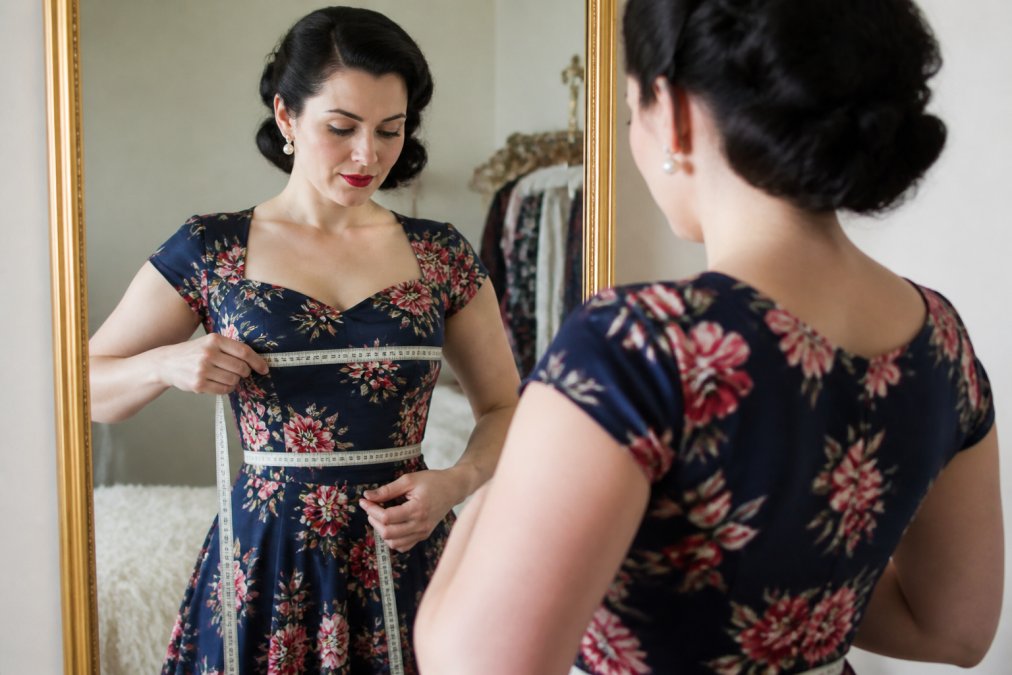
Taking Accurate Bust, Waist, and Hip Measurements
For bust measurement, wrap the tape around the fullest part of your chest, keeping it parallel to the ground. The tape should sit snugly with one finger able to slip underneath.
Measuring Inseam, Rise, and Shoulder Width
Inseam is critical for vintage pants and skirts: measure from the crotch seam down to your ankle bone. For skirt length, measure from your natural waistline to desired hem.
Vintage Clothing Size Conversion Chart for Women
A vintage clothing size conversion chart is your most practical tool when shopping for retro apparel. The conversions below represent typical sizing standards for each era.
| Era | Vintage Size | Typical Bust | Typical Waist | Typical Hip | Modern Equivalent |
|---|---|---|---|---|---|
| 1950s | 8 | 32" | 24" | 34" | 0-2 |
| 1950s | 10 | 34" | 26" | 36" | 2-4 |
| 1950s | 12 | 36" | 28" | 38" | 4-6 |
| 1960s-70s | 8 | 33" | 25" | 35" | 2-4 |
| 1960s-70s | 10 | 35" | 27" | 37" | 4-6 |
| 1980s | 6 | 34" | 26" | 36" | 2-4 |
| 1980s | 8 | 36" | 28" | 38" | 4-6 |
| 1990s | 6 | 35" | 27" | 37" | 4-6 |
| 1990s | 8 | 37" | 29" | 39" | 6-8 |
1950s to Modern Size Conversions
The 1950s represents the most dramatic sizing shift. A 1950s size 12 is approximately a modern size 4 or 6. This era prioritized fitted silhouettes emphasizing the waist, with significantly smaller measurements than today.
1960s-1980s Size Mapping
A 1970s size 10 is roughly equivalent to a modern size 6, with higher waistline and straighter cut. By the 1980s, sizing moved toward modern conventions, so an 1980s size 8 fits similarly to a modern size 6, with higher rise and broader shoulders.
Fit Types: Classic, Oversized, and Slim Silhouettes
Retro apparel comes in distinct fit categories reflecting different eras' design philosophies. Understanding these helps predict how a piece will look.
Body Type-Specific Retro Styling and Fit
Different body types work with vintage silhouettes in distinct ways. Understanding your body type helps you select retro apparel that flatters your natural proportions.
Tips for Buying Vintage-Inspired Clothing Online
Shopping for retro apparel online requires different strategies than in-person shopping. You can't try things on, so detailed information becomes your best tool.
How to Read Vintage Size Tags and Fabric Composition
Vintage size tags tell a story about when and where a garment was made. Tags from the 1950s are typically sewn directly into the seam and feature simple, straightforward sizing. By the 1970s, tags became more detailed and sometimes included fiber content and care instructions.
Evaluating Stretch and Construction Quality
Check whether the fabric has any stretch. Vintage pieces made from natural fibers typically have minimal stretch, while pieces with nylon or spandex content offer more give. This affects how closely the garment must fit, a dress with no stretch requires precise measurements, while one with 4-way stretch offers more forgiveness.
The Vanity Sizing Evolution and What It Means for You
Vanity sizing, the practice of making garments larger while keeping the size label the same, has accelerated dramatically since the 1990s. A modern size 8 contains significantly more fabric than a size 8 from 20 years ago. This trend has made vintage sizing guides even more essential for accurate fitting.
Frequently Asked Questions
How does a vintage size 10 compare to modern women's sizing?
A vintage size 10 from the 1950s typically corresponds to a modern size 6 or 8, depending on the era and brand. Vintage sizing ran smaller because body measurements and manufacturing standards were different. A 1950s size 10 had a bust measurement around 35-36 inches, while a modern size 10 measures 38-39 inches. Always check specific garment measurements rather than relying on size numbers alone when buying retro apparel.
Does vintage clothing run small?
Yes, vintage clothing generally runs smaller than contemporary apparel. This is due to vanity sizing evolution, manufacturers have gradually increased garment dimensions while keeping size labels the same. Additionally, vintage pieces were often designed for different body proportions and manufacturing techniques. A 1960s dress labeled size 12 may fit like a modern size 8. Always measure yourself and compare your measurements to the specific garment's dimensions rather than trusting the size label alone.
What measurements should I take when buying retro dresses online?
Measure your bust at the fullest point, waist at the narrowest part, and hips at the widest point. When buying vintage-inspired clothing online, compare these measurements directly to the garment's listed dimensions. Fabric composition matters too, a dress with 4-way stretch will fit differently than one with no elasticity. Always request a size chart from the seller before purchasing.
What is the difference between authentic vintage and modern retro-inspired sizing?
Authentic vintage pieces follow the sizing standards of their era and often run significantly smaller. Modern retro-inspired clothing, like Steady Clothing's designs, is typically manufactured to fit contemporary body measurements while maintaining the vintage aesthetic. Retro-inspired pieces often include stretch fabrics. If you're used to modern sizing, retro-inspired garments will feel more familiar, though vintage authentic pieces may require sizing up considerably.
Why should I care about fabric composition when buying retro apparel?
Fabric composition directly affects how a vintage-inspired garment fits and moves on your body. Natural fibers like rayon and cotton have minimal stretch, while blends with spandex or nylon offer 4-way stretch for comfort and a closer fit. Vintage pieces often used rigid fabrics, while modern retro designs frequently incorporate stretch for better body accommodation. Check the material percentage, higher spandex content means more flexibility, which is especially important for curvy body types wearing fitted silhouettes.
How do I know if a retro dress will fit my curvy body type?
Look for garments designed with stretch fabric and constructed to follow curves. Pieces with 4-way stretch fabrics like those used in Steady Clothing's Diva Dress accommodate curves while maintaining shape. Check the rise and waist-to-hip ratio on the size chart, vintage pieces often had higher waists and less hip room. Consider fit types: wiggle dresses and pencil skirts hug curves intentionally, while swing styles offer more room. Always verify bust, waist, and hip measurements match your body, and read reviews from customers with similar body types.
What should I look for when reading vintage size tags?
Check the era the garment is from, 1950s, 1960s, and later decades had different sizing standards. Look for fiber content and care instructions, which tell you about fabric behavior and stretch potential. Some vintage tags list measurements rather than sizes; use these numbers to compare against your own measurements. Be aware that vanity sizing started appearing in vintage pieces from the 1970s onward, so a 1970s size 10 may be slightly larger than a 1950s size 10. When in doubt, prioritize actual measurements over the labeled size.
Is size inclusivity available in retro apparel?
Yes, modern retro-inspired brands increasingly offer extended size ranges to accommodate different body types. Steady Clothing designs retro apparel with a focus on fitting curvy body types. However, authentic vintage pieces have limited size availability since they were manufactured decades ago. If you're looking for size-inclusive retro apparel, modern reproduction clothing and contemporary retro-inspired brands offer better options than hunting for authentic vintage pieces.