How to Verify American Made Apparel

Table of Contents
- Understanding FTC Made in USA Labeling Requirements
- How to Identify Authentic American Made Clothing
- Visual Inspection Checklist for Domestic Production
- Common Labeling Loopholes and Misleading Claims
- Benefits of Domestic Apparel Manufacturing
- Third-Party Certifications and Verification Tools
- How to Verify American Made Apparel When Buying Online
- Conclusion
- Frequently Asked Questions
Last Updated: September 26, 2026
Understanding FTC Made in USA Labeling Requirements
The Federal Trade Commission sets the standard for what "Made in USA" actually means. It's not vague, and it's not optional. If a company claims a product is made in the USA, the FTC requires that claim to be truthful and substantiated.
The 'All or Virtually All' Standard
The "all or virtually all" standard is the backbone of FTC Made in USA labeling requirements. This means that all significant parts and processing of the product must be sourced and completed in the USA. The FTC doesn't specify an exact percentage, but "virtually all" typically means 85% or higher of the product's value comes from domestic sources.
What does this mean in practice? For a bowling shirt, the fabric, buttons, thread, and labor must all originate domestically. If a manufacturer imports buttons from overseas or sources fabric from abroad, the garment cannot legally carry a "Made in USA" label. The FTC's Guides Concerning the Use of the "Made in USA" Labeling provide the official framework that retailers and manufacturers must follow.

This standard applies across all product categories, but enforcement varies. Apparel manufacturers face particular scrutiny because textile sourcing is complex and supply chains are often fragmented.
The Difference Between 'Made in' and 'Assembled in'
This distinction matters more than most consumers realize. A product labeled "Made in USA" must meet the "all or virtually all" standard. A product labeled "Assembled in USA" has a much lower bar, it only requires final assembly to occur domestically.
"Assembled in" is a legal loophole. A manufacturer can import 95% of components, assemble them here, and legally claim "Assembled in USA." The product never had to be designed, engineered, or manufactured domestically. Only the final step had to happen on domestic soil.
Here's the practical difference: when you buy a vintage-inspired bowling shirt labeled "Made in USA," you're getting domestic fabric, domestic buttons, and domestic labor. When you see "Assembled in USA," you might be getting imported components put together here. The value added domestically is minimal.
Steady Clothing distinguishes itself by committing to full USA manufacturing. Our bowling shirts use domestic materials and domestic labor throughout the entire process, not just assembly.
How to Identify Authentic American Made Clothing
To verify American made apparel, you need to check multiple signals. No single marker is foolproof, but together they paint a clear picture.
Step 1: Check the Hang Tag and Care Label
Start with the hang tag and care label. These are legally required to disclose the country of origin. Look for "Made in USA" printed clearly on the tag. The text should be legible and permanent, not faded or peeling off.
Check the care label itself. Care labels are typically attached to the garment's interior seam. On authentic American-made apparel, this label will state the country of origin and often include the manufacturer's name or location. If the label says "Made in China" or "Made in Vietnam," the garment is not domestically manufactured, regardless of what the hang tag claims.
Pay attention to label quality. Cheap labels with poor printing, misaligned text, or obvious typos are red flags. Legitimate manufacturers invest in professional labeling. If the label looks hastily printed or poorly attached, question the authenticity of the entire claim.
Step 2: Verify the Manufacturing Facility
Research the manufacturer directly. Authentic American-made apparel companies are typically transparent about where production happens. Check the company's website for facility information, location details, or manufacturing transparency statements.
Contact the company and ask specific questions: Where is your facility located? What percentage of production is domestic? Do you have a tour option or facility photos? Legitimate manufacturers welcome these questions. If a company dodges the question or becomes evasive, that's a warning sign.
For vintage-inspired brands like Steady Clothing, manufacturing transparency is a core value. Domestic production is central to our brand identity.
Step 3: Inspect Fabric and Component Origins
Examine the fabric itself. American-made apparel typically uses higher-quality textiles sourced from domestic mills. Feel the fabric's weight, drape, and finish. Cheap imported fabrics often feel thin or plasticky.
Check the buttons, zippers, and other hardware. These components carry origin information too. Look for any markings indicating where buttons or hardware were sourced. If buttons are marked "Made in China" or "Made in Taiwan," the garment cannot legally claim "Made in USA" status.
Poplin Wide Panel Bowling Shirt in →
Inspect the stitching and seams. Domestic manufacturing typically involves more careful construction. Look for even, tight stitching with no loose threads. Check seams for reinforcement, American-made apparel often includes double-stitched seams or reinforced stress points. This attention to detail is a hallmark of domestic production.
Visual Inspection Checklist for Domestic Production
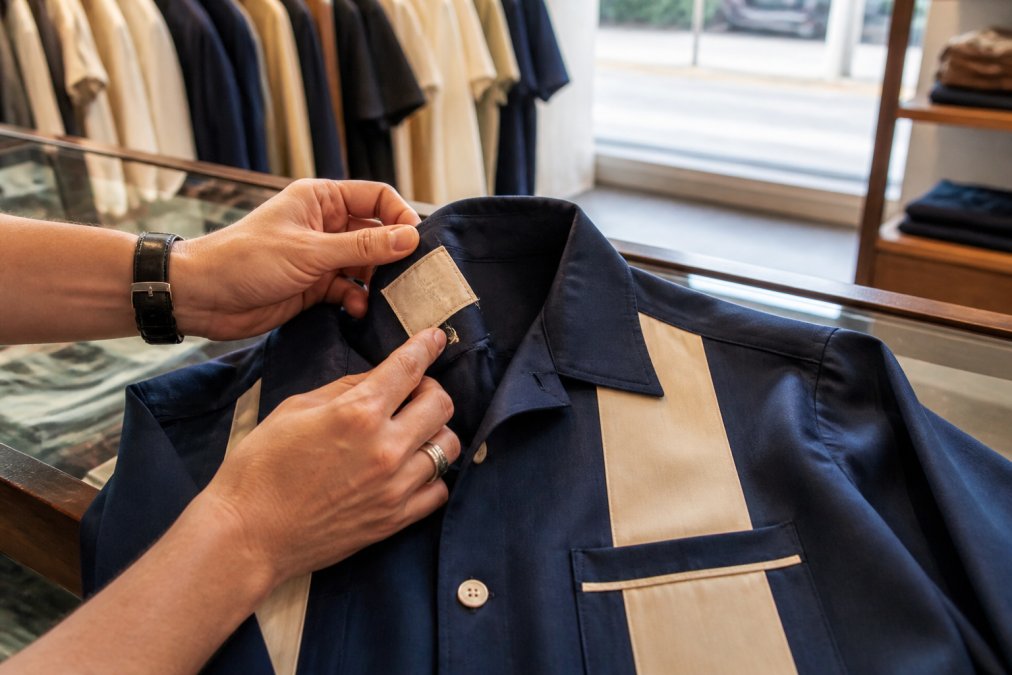
Use this checklist when evaluating whether a garment is truly American-made:
- Hang tag clarity: Is "Made in USA" printed clearly and professionally on the hang tag?
- Care label legibility: Does the interior care label state "Made in USA" in permanent, professional text?
- Fabric quality: Does the fabric feel substantial and well-finished, not thin or plasticky?
- Button markings: Check buttons for origin markings. Domestic buttons should not indicate foreign manufacture.
- Seam construction: Are seams double-stitched or reinforced at stress points?
- Thread quality: Is the thread even and tight throughout, with no loose or fraying threads?
- Label attachment: Is the care label securely sewn, not glued or stapled?
- Stitching uniformity: Are stitches consistent in size and tension across the entire garment?
- Hardware quality: Do zippers, snaps, or other hardware feel solid and well-finished?
- Hem finish: Is the hem sewn with multiple passes or reinforced, indicating quality construction?
Each of these signals individually is not definitive, but together they indicate whether a garment received proper domestic manufacturing attention.
Common Labeling Loopholes and Misleading Claims
Several tactics allow companies to make misleading claims about American production. Understanding these loopholes protects you from false marketing.
"Assembled in USA" without full domestic manufacturing is the most common loophole. A garment can legally claim "Assembled in USA" even if 90% of the product was imported. Only the final assembly step needs to happen domestically.
"Made in USA with imported materials" is another deceptive claim. This phrase technically complies with FTC guidelines but misleads consumers into thinking the product is fully domestic. The product may contain significant foreign components while only the assembly or finishing touches happened domestically.
Vague origin claims like "Proudly crafted in America" or "American-inspired" don't actually claim domestic manufacture. These phrases avoid legal liability while creating the impression of American production. If a company won't explicitly state "Made in USA," question why.
Missing or illegible labeling is a major red flag. If you can't find clear origin information on the hang tag or care label, assume the product is not domestically made. Legitimate American manufacturers proudly display this information.
Partial truths occur when companies highlight one domestic element while hiding foreign origins.
Benefits of Domestic Apparel Manufacturing
American manufacturing delivers tangible benefits beyond patriotism. Understanding these advantages explains why consumers choose domestically produced apparel.
Third-Party Certifications and Verification Tools
Third-party certifications add an extra layer of credibility to American-made claims. These certifications indicate that an independent organization has verified the manufacturer's practices.
How to Verify American Made Apparel When Buying Online
Online shopping makes verification harder because you can't inspect the garment before purchase. These strategies help you verify authenticity before committing to a purchase.
| Verification Method | What to Look For | Red Flags |
|---|---|---|
| Hang Tag | "Made in USA" printed clearly and professionally | Faded text, missing label, or "Assembled in USA" only |
| Care Label | Interior label stating "Made in USA" and manufacturer name | Foreign origin stated or label is poorly attached |
| Fabric Quality | Substantial weight, smooth finish, professional feel | Thin, plasticky, or cheap-feeling material |
| Buttons and Hardware | Domestic origin markings or no foreign markings visible | "Made in China" or "Made in Taiwan" markings |
| Seam Construction | Double-stitched or reinforced seams, even tension | Loose, uneven, or single-stitched seams |
| Company Transparency | Facility location, supply chain details, manufacturing info | Vague descriptions, no manufacturing information available |
Conclusion
Verifying American-made apparel requires attention to multiple details, from hang tag language to seam construction to company transparency. The FTC's "all or virtually all" standard sets the legal requirement, but your job as a consumer is to verify that companies actually meet this standard.
Frequently Asked Questions
What does the FTC require for a 'Made in the USA' label?
The FTC requires that all or virtually all the product's components be made in the USA and all significant processing occur domestically. This means the fabric, thread, buttons, and other materials must originate from the USA, and the garment must be assembled here. If imported components make up more than a minimal portion, the label must say 'Assembled in the USA' or identify the foreign origin. Violations can result in FTC enforcement action against manufacturers making false claims.
How can you tell if a product is truly made in the USA versus just assembled here?
Check the care label and hang tag for specific wording. 'Made in the USA' means all or virtually all production occurred domestically. 'Assembled in the USA' indicates final assembly happened here but components may be imported. Ask the brand directly about fabric sourcing and manufacturing location. Domestic manufacturers like Steady Clothing transparently identify where production occurs.
What are common labeling loopholes companies use to mislead consumers?
Some brands use vague terms like 'Proudly Assembled in the USA' without disclosing imported fabrics or components. Others claim 'Made in USA' when only final assembly happens domestically. Some use patriotic imagery without accurate labeling. Watch for brands that avoid specific origin claims or use terms like 'American-inspired' instead of 'Made in the USA.' The FTC actively enforces against these practices, but reading labels carefully protects you from misleading claims.
Why should I pay more for American-made apparel?
Domestic manufacturing typically means higher labor standards, stricter quality control, and shorter supply chains that reduce defects. American-made garments often feature better stitching, durable fabrics, and attention to detail. You support domestic jobs and manufacturing standards. Vintage-inspired brands like Steady Clothing offer customization options and bulk production capabilities that domestic facilities can accommodate more flexibly than overseas manufacturers, ensuring your specific needs are met without compromise.