7 Steps to Find Vintage Clothing Shops Near You

Last Updated: October 29, 2026
Quick Summary
Finding vintage clothing shops near you starts with a map search set to a 5-mile radius, widening to 10 only if results dry up. Verify each shop is still open by checking recent reviews and the shop's own social page before you drive. Then search by neighborhood to catch shops a single near-me search misses.
- A vintage clothing shop sells secondhand garments organized by era, style, or size, unlike a thrift store.
- Treat a shop as unconfirmed if its newest review is over six months old.
- Read two- and three-star reviews first to surface real friction like cramped fitting rooms.
- Bring your own measurements, not your clothing size, since vintage sizing runs small.
- Group shops by neighborhood and plan two to three stops per trip.
Table of Contents
- Start With a Map Search and a Realistic Radius
- Read Reviews and Confirm Hours Before You Go
- How to Shop for Vintage Clothes Without Wasting a Trip
- How to Tell If Clothes Are Vintage: Labels, Seams, and Fabric
- A Vintage Clothing Size Guide for Real Bodies
- Compare Prices Across Thrift, Consignment, and Resale
- Plan Your Visit, Then Order Custom Retro Pieces in Bulk
- Frequently Asked Questions
Start With a Map Search and a Realistic Radius
Finding vintage clothing shops near me starts with a map search, but the radius you choose and how you verify each result matter more than the search engine.
Search "vintage clothing shops near me" and set your radius to 5 miles first, widening to 10 only if results dry up. A tight radius keeps you in neighborhoods where independent shops cluster.
A vintage clothing shop sells secondhand and pre-owned garments, typically organized by era, style, or size, which separates true vintage stores from thrift stores that happen to stock a few old pieces.
Here is the sequence we recommend:
- Open your map app and search the exact phrase
- Set a 5-mile radius and note every result
- Save the ones that describe themselves as vintage or curated
- Cross-check the business hours before you drive anywhere
The Google Maps help center guide to searching nearby walks through saving places and filtering results, which saves you from re-searching the same phrase every weekend.
Verify a Shop Is Still Open Before You Drive
A map pin is not proof a shop is operating. Small vintage stores close for buying trips, change hours by season, and sometimes shut down without updating their listing. Before you commit to a drive, run this three-step check:
- Check the hours line, not just the pin. A listing with no hours or "Hours may differ" is a warning sign. Call during posted hours.
- Look at the most recent review date. If the newest review is over six months old, treat the shop as unconfirmed until you reach someone by phone.
- Check the shop's own social page. Most independent vintage shops post current hours, closures, and new stock to Instagram or Facebook before updating a map listing.
Search by Neighborhood, Not Just by Radius
A radius search returns whatever is closest, not where vintage shops cluster. Once you have a shortlist, re-run the search using neighborhood names or main streets to surface shops just outside your radius but inside a walkable district.
- Search the name of a known vintage or arts district plus "vintage clothing"
- Search a main street name plus "thrift" or "consignment"
- Use the map's "search this area" button after panning to a new neighborhood
This two-pass method, radius first, neighborhood second, catches shops a single near-me search misses.
Filter by Store Type, Not Just Distance
Distance is a poor filter on its own. A thrift store two blocks away may stock nothing from before 2010, while a consignment shop 8 miles out could hold a rack of 1950s bowling shirts.
Sort your results into three buckets:
- Thrift store: Donation-based, low prices, unpredictable inventory, rarely curated by era
- Consignment shop: Sellers consign items, staff often curate by style, mid-range prices
- Resale store: Buys inventory outright, usually more selective, higher prices for better condition
Most map listings label themselves clearly. When they do not, check the shop's website or social page. A store that photographs individual pieces and dates them is usually a curated vintage shop.
Read Reviews and Confirm Hours Before You Go
Reviews tell you what the shop's own listing will not.
Then confirm hours directly. Small vintage shops change hours seasonally, close for buying trips, and post last-minute closures on social media.
Driving to a shop without confirming hours is the most common wasted trip in local resale shopping.
Use a quick pre-visit checklist:
- Hours confirmed within the last 7 days
- Address and parking situation checked
- Recent photos reviewed for the styles you want
Reviews also reveal inventory turnover. A shop posting fresh photos weekly is actively buying stock; one with photos from two years ago is probably coasting on the same rack.
How to Shop for Vintage Clothes Without Wasting a Trip
Shopping for vintage clothes rewards preparation. The best shoppers arrive with measurements, a budget, and a plan to inspect before they buy.
Bring your own measurements, not your clothing size. Accurate numbers provide a reliable foundation for spotting quality clothing while you evaluate the construction and fabric integrity of each vintage find.
Then follow this in-store routine:
- Scan the whole shop once before pulling anything
- Check the tag and seams on every piece you like
- Hold garments up to natural light for stains and thinning
- Try on anything within an inch of your measurements
- Ask staff about unmarked stock in back
A common mistake is heading straight for the rack that matches your usual size.
For sustainable shopping, remember that buying secondhand keeps garments in circulation. The EPA guidance on reducing and reusing materials explains how reuse cuts textile waste, which is a genuine reason to favor resale over new fast fashion when the piece fits.
How to Tell If Clothes Are Vintage: Labels, Seams, and Fabric
Telling if clothes are vintage comes down to three checks: the label, the seams, and the fabric. Each one gives you a different clue, and together they separate genuine vintage from modern "vintage-inspired" reproductions.
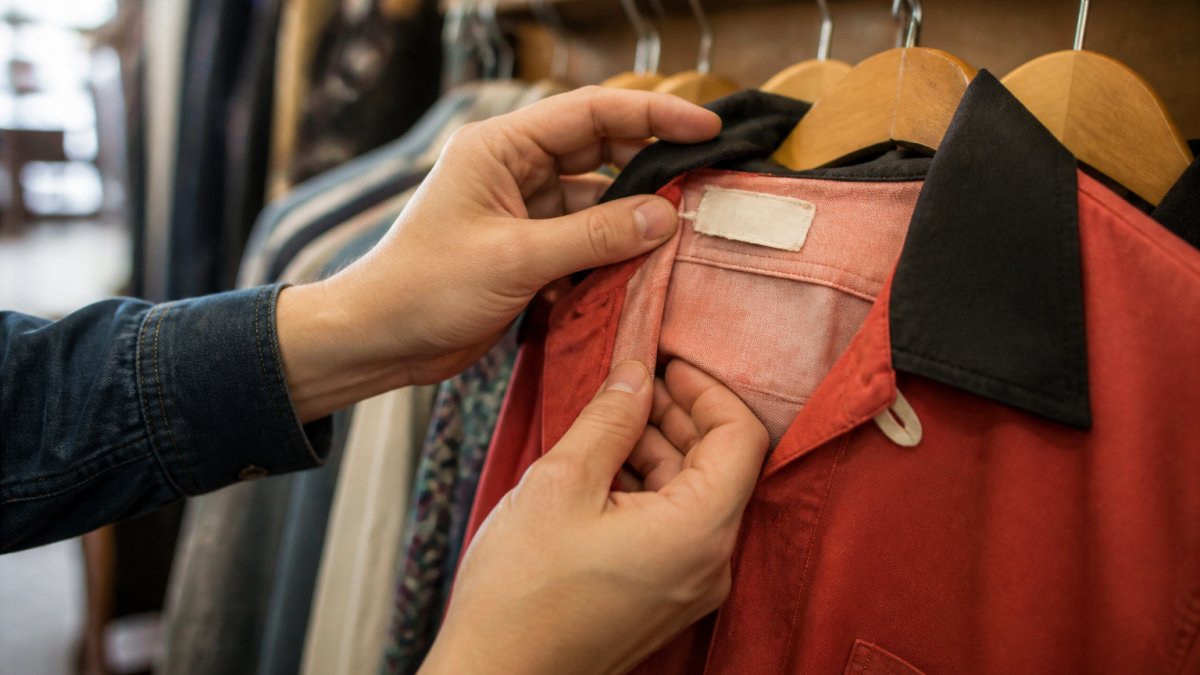
Start with the label. Union-made tags, fiber content requirements, and care instructions all changed at different points in history.
Then check the seams. Look inside the garment at the side and shoulder seams:
- Pinked seams: zigzag-cut edges, common in older garments
- Serged seams: overlocked edges, standard from the 1970s onward
- French seams: enclosed edges, often on higher-quality pieces
Fabric is the third check. Early synthetic blends feel different from modern polyester, and older cotton tends to have a denser, drier hand.
For a deeper look at era-specific details, our guide to authentic 1950s style clothing for men breaks down the collar shapes, fabric choices, and construction marks that define that decade.
A Vintage Clothing Size Guide for Real Bodies
Vintage sizing does not match modern sizing, and the gap is bigger than most shoppers expect.
Build a personal size chart before you shop. Measure a garment you already own that fits well, flat, and write down:
- Pit-to-pit across the chest
- Waist, measured flat and doubled
- Hip, measured at the widest point
Carry those numbers and compare them to garments in the shop with a tape measure. Most vintage shops keep one at the counter.
Curvier shoppers face a specific challenge: many vintage pieces were cut for narrower hip and bust proportions. Our guide to finding retro clothing for curvy bodies covers which eras and cuts work best, and the vintage sizing guide goes deeper on translating old size numbers into real measurements.
Watch out: assuming a vintage piece will fit because the tag matches your usual size. Always measure, and try on when the shop allows it.
Compare Prices Across Thrift, Consignment, and Resale
Prices vary widely by store type, and knowing the range keeps you from overpaying or walking away from a fair deal. Here is how the three main channels compare, plus a method for pricing a specific piece.
| Store Type | Typical Price Level | Inventory Quality | Best For |
|---|---|---|---|
| Thrift store | Lowest | Unpredictable, mixed eras | Bargain hunting, casual browsing |
| Consignment shop | Mid-range | Curated, better condition | Named eras, quality pieces |
| Resale store | Highest | Selective, often authenticated | Statement pieces, rare finds |
| New vintage-inspired | Fixed retail | Consistent sizing, new stock | Everyday wear, guaranteed fit |
Thrift stores price low because inventory is donated. You will dig through a lot of modern clothing for one good piece. Consignment and resale shops do the sorting for you and charge for that labor.
What Drives the Price of a Vintage Piece
Two garments from the same decade can sit $40 apart on the same rack. The difference usually comes down to a handful of factors:
- Era and rarity: Pieces from the 1950s and earlier are scarcer than 1990s items and usually carry a premium.
- Condition: Stains, thinning, missing buttons, and broken zippers pull the price down. Deadstock, never worn, often with original tags, commands more.
- Label and maker: Recognized heritage labels and union-made tags add value for collectors.
A common pattern is a shop pricing a plain 1980s blouse at $12 and a 1960s mod dress at $85 in the same store. The gap is era, condition, and construction.
A Method for Comparing Value
Before you buy, run a quick three-part check:
- Compare against the same era, not the same rack. A 1970s polyester shirt and a 1950s cotton shirt are not comparable. Price the piece against others from its decade.
- Add up the repair cost. A $20 jacket with a broken zipper may cost more to fix than a $45 jacket that needs nothing. Ask the shop whether they do repairs or can recommend someone.
- Check the new alternative. If a classic silhouette you plan to wear weekly is available new in your size at a fixed retail price, compare that against a vintage piece that may need alterations.
Value depends on what you want. A one-of-a-kind 1950s piece justifies a resale price. A classic bowling shirt silhouette you plan to wear weekly is often better bought new, where the sizing is predictable and the fabric is durable. That is the trade-off most price comparison guides skip.
Plan Your Visit, Then Order Custom Retro Pieces in Bulk
A good visit starts with a route. Group shops by neighborhood, plan two to three stops per trip, and leave the biggest shop for last when you have the most energy. Bring a tape measure, your measurements, and cash for shops that do not take cards.
When you find a style you love but cannot source in your size or quantity, custom retro apparel fills the gap. Our retro classics collection covers the core silhouettes, from The Retro Ricky in Navy at $67.99 to The Triple Diamond in Black at $69.99, both made in the USA. For groups, our guide to custom bowling shirts for groups explains how bulk orders work for car clubs, bars, and event teams.
Finding genuine vintage takes a tighter radius, a measurements-first mindset, and a willingness to check labels and seams before you fall for a piece.
Frequently Asked Questions
How do I find vintage clothing shops near me?
Start with a map search for vintage clothing and set a radius you will actually drive, usually 10 to 15 miles in a metro area. Filter results by store type: thrift stores, consignment shops, and resale stores carry very different stock. Check reviews for mentions of curated selection and inventory turnover, confirm business hours the same day, and call ahead if you are chasing a specific era or size.
How can I tell if clothing is genuinely vintage?
Check the label, seams, and fabric. Paper or woven labels with union markings point to older manufacturing, while serged overlock seams suggest later production. Metal zippers, single-stitch hems, and fabrics like 100% polyester or wool blends are common in mid-century pieces. Ask the shop staff what they know about the item's history, and compare construction details across several garments before you commit.
Are vintage clothing stores more expensive than thrift stores?
Usually yes. Thrift stores price by category and move volume, while consignment and resale shops inspect, clean, and curate each piece, so prices reflect that labor. Expect to pay more for documented era pieces and less for general secondhand clothing. If budget matters, shop thrift first for basics and save consignment visits for statement items like handbags, shoes, and embroidered shirts.
How do I find my size in vintage clothing?
Ignore the tag number and measure yourself first: bust, waist, hips, and shoulder width. Vintage sizing runs smaller than modern sizing, and garments shrink over decades, so compare your measurements to the garment laid flat, doubled where needed. Bring a tape measure to the shop, try pieces on when allowed, and size up when a fabric has no stretch.
