How to Calculate Cost Per Wear for Premium Clothing

Quick Summary
Cost per wear is the purchase price divided by the number of times you wear the item. To calculate cost per wear for premium clothing, estimate realistic wears, add care and repair costs, then divide the total by those wears. A higher price can still give a lower cost per wear when the garment lasts.
- Cost per wear = Purchase price ÷ Number of wears.
- Count only the wears you would realistically reach for, not ideal ones.
- Multiply wears per week by usable weeks per year, not 52.
- Cut your first wear estimate by 25 to 40 percent for discipline.
- Add care, repair and alteration costs for the full cost per wear.
Table of Contents
- What Cost Per Wear Means for Premium Clothing
- The Basic Cost Per Wear Formula
- Step-by-Step: Estimating How Often You Will Wear an Item
- Cost Per Wear Clothing Examples: Premium vs. Budget
- Counting the Full Ownership Cost: Care, Repairs, and Alterations
- How to Track Clothing Wears Over Time
- Using a Cost Per Wear Calculator and Deciding on Your Next Piece
- Frequently Asked Questions
What Cost Per Wear Means for Premium Clothing
Last Updated: November 13, 2026
Cost per wear is the price of a piece of clothing divided by the number of times you wear it. A jacket you wear 100 times costs far less per wear than a shirt you wear twice, even though it costs more upfront.
This simple idea is the core of calculating cost per wear for premium clothing. Shoppers often judge a piece by its sticker price alone. Cost per wear shifts the focus to how much use you get from it over time.
Generally, well-made garments can earn their keep through durability, fit and versatility, holding their shape and surviving repeated washing. See the long-term benefits of American made retro apparel that justify paying more. That lifespan is what spreads the purchase price across many more wears.
Most budget pieces lose their appeal after a season or two. They pill, stretch or fall apart, so the true cost climbs fast.
The Basic Cost Per Wear Formula
The formula is straightforward:
Cost per wear = Purchase price ÷ Number of wears
Here is how it works in practice:
- Purchase price: What you paid for the item
- Number of wears: How many times you expect to wear it before it is no longer useful
The more you wear something, the lower its cost per wear becomes.
Keep the number of wears honest. Count only the times you would actually reach for the piece, not the times you might.
Step-by-Step: Estimating How Often You Will Wear an Item
Estimating wears is the hardest part of the calculation, and it is where most cost-per-wear estimates go wrong. A repeatable forecast beats a hopeful guess. Use this five-factor method to build a wear estimate you can defend.
- Map the occasions. List every setting where the item genuinely fits: workdays, weekends, travel, events, or specific dress codes. Be specific about frequency. "Work" might mean five days a week, while "events" might mean six times a year.
- Check wardrobe compatibility. Count how many existing pieces the new item works with. A jacket that pairs with three outfits will be worn far less than one that pairs with ten. If you cannot name at least three complete outfits it slots into, cut your estimate.
- Adjust for climate and season. A heavy coat may only be usable four months a year in a cold climate, while a linen shirt may work five months in a warm one. Multiply your weekly estimate by the number of usable weeks, not 52.
- Set a realistic lifespan. Premium clothing often lasts longer, but lifespan depends on fabric, construction, and care. A tailored wool coat worn regularly may hold up for eight to ten years with proper maintenance; a lightweight knit may last three to five. Use the lower end unless you have evidence otherwise.
- Apply a discipline discount. Most people overestimate wears by a wide margin. A common pattern is to cut the first estimate by 25 to 40 percent. If your math says 200 wears, plan for 120 to 150.
Here is the forecast in formula form:
Expected wears = (Usable weeks per year × Wears per week) × Expected years of wear × Discipline discount
Worked example: a $420 wool overcoat worn three times a week for 20 usable weeks a year, kept for eight years, with a 30 percent discount:
- 20 weeks × 3 wears = 60 wears per year
- 60 × 8 years = 480 wears
- 480 × 0.70 = 336 expected wears
- $420 ÷ 336 = about $1.25 per wear
Watch out: counting ideal wears instead of real ones is the most common mistake. Learn how to verify that a premium piece is truly well-made and American made before you pay for it. A pair of dress shoes may look perfect for every event, but most people wear them far less often than they plan. If you cannot point to specific occasions on your calendar, assume the item will be worn less, not more.
For premium pieces, run the forecast twice: once with your optimistic number and once with a conservative one. If the purchase only makes sense at the optimistic number, it is probably not a good value.
The five-factor method breaks the wear estimate into steps you can check before buying.
| Step | What to do | Adjustment |
|---|---|---|
| Map the occasions | List every setting where the item fits | Be specific about frequency |
| Check wardrobe compatibility | Count outfits the item pairs with | Cut estimate if fewer than three outfits |
| Adjust for climate and season | Count usable weeks, not 52 | Multiply by usable weeks |
| Set a realistic lifespan | Use the lower end of the range | Unless you have evidence otherwise |
| Apply a discipline discount | Cut the first estimate | Reduce by 25 to 40 percent |
Cost Per Wear Clothing Examples: Premium vs. Budget
Comparing equivalent pieces shows the difference clearly, but the comparison is only honest when it includes ownership costs and realistic wear counts. The examples below use premium-specific categories: outerwear, footwear, and tailoring.
Example 1: Wool overcoat
- Premium coat: $420 purchase price, $60 in lifetime dry cleaning, worn 300 times over 8 years = $1.60 per wear
- Budget coat: $110 purchase price, $20 in cleaning, worn 40 times before the lining fails = $3.25 per wear
The budget coat looks cheaper on the tag, but it costs roughly twice as much per wear. The premium coat also avoids the replacement cycle.
The pattern to watch for: the more often and the longer you wear an item, the lower its cost per wear, so run the math on the pieces you actually plan to buy.
Counting the Full Ownership Cost: Care, Repairs, and Alterations
The purchase price is only part of the story. A complete ownership cost adds the other expenses:
Total ownership cost = Purchase price + Care costs + Repair costs + Alteration costs
Include these items:
- Care: Dry cleaning, specialty detergents or cold-wash cycles
- Repairs: Replacing buttons, mending seams or re-soling shoes
- Alterations: Hemming, taking in the waist or adjusting sleeves
Then divide the total by the number of wears:
Full cost per wear = Total ownership cost ÷ Number of wears
A garment that needs frequent repairs or dry cleaning can cost far more over its life than its price tag suggests. A well-constructed piece often needs less upkeep, which keeps the full cost per wear low.
How to Track Clothing Wears Over Time
Tracking turns a guess into real data. The more accurate your wear count, the better your cost-per-wear figures become.
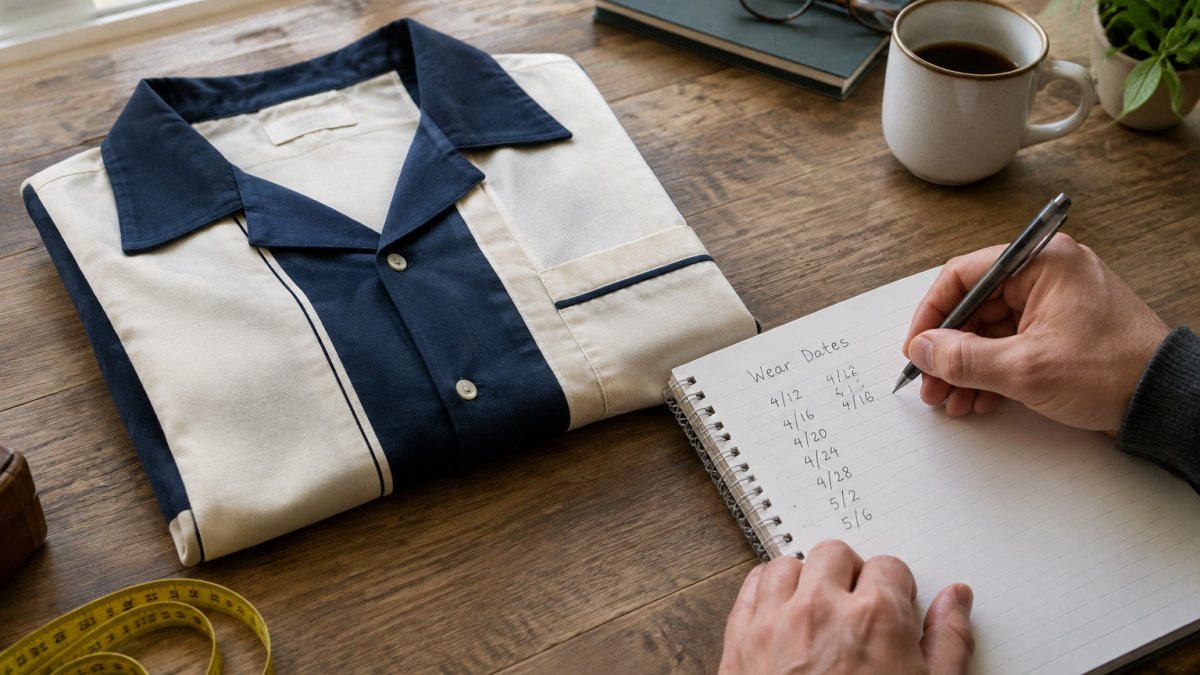
Try one of these methods:
- Use a notebook. Write the item name and date each time you wear it.
- Use a spreadsheet. Create columns for item, purchase price, wear dates and total wears.
- Check the calendar. Log outfits in your phone calendar or a fashion tracking app.
Review your log every few months. Items with low wear counts may be poor purchases to repeat. Items with high counts show you where your money works hardest.
!A person's hands writing wear dates in a notebook beside a folded retro bowling shirt on a wooden table in soft natural light
Using a Cost Per Wear Calculator and Deciding on Your Next Piece
Before you buy, run the numbers. Use this checklist:
- Estimate realistic wears over 2 to 5 years
- Add expected care, repair and alteration costs
- Divide the total cost by the expected wears
- Compare the result with a similar budget option
You can build this into a simple spreadsheet or use a cost per wear calculator. Enter the price, the expected wears and any upkeep costs. The result shows whether a premium piece earns its place in your wardrobe.
If you want to see how this plays out with real pieces, browse our authentic 1950s style clothing for men and compare the expected wears against the price. For more on how we build garments to last, read why quality craftsmanship matters in clothing. Our retro apparel sizing guide for women can also help you choose a fit you will actually wear often.
Frequently Asked Questions
What is the formula for calculating cost per wear?
Divide the purchase price of an item by the number of times you wear it. A $300 jacket worn 60 times has a cost per wear of $5. To make the number useful, plan your wear count honestly: include the wears you expect over the garment's realistic life, not just the first season. Recalculate as the wear count grows, because the figure drops with each use and shows whether a premium piece is earning its price over time.
What is considered a good cost per wear?
There is no universal threshold, but a lower number means the item is earning its price. Many buyers compare the result against what they would pay for a cheaper replacement that wears out sooner. If a premium shirt costs $90 and you wear it 45 times, the cost is $2 per wear, which may beat a $30 shirt you wear 5 times before it loses shape. The right benchmark is the cost of the alternative you would otherwise buy.
Should alterations and repairs be included in cost per wear?
Yes, for an accurate picture of ownership cost. Add the price of tailoring, repairs, and specialized care to the purchase price, then divide by the wears. Including these costs prevents the calculation from understating what a garment actually costs to keep in wearable condition.
Is cost per wear a reliable way to judge clothing quality?
It is a useful value measure, but not a direct quality test. A high price does not guarantee durability, so check the fabric, construction, and stitching as well. Cost per wear works best when you pair it with a realistic wear estimate and an honest look at whether the piece fits your existing wardrobe. Use it to compare items you are seriously considering rather than to rank quality on its own.
