Benefits of Custom Embroidered Staff Uniforms

Table of Contents
- Why Custom Embroidered Staff Uniforms Matter for Your Business
- How Custom Embroidered Staff Uniforms Build Brand Identity and Recognition
- Staff Uniform Advantages and Disadvantages: What You Need to Know
- Embroidery vs. Printing for Uniforms: Durability and Cost Comparison
- Embroidered Work Shirts with Logo: Design, Placement, and Selection
- Employee Morale, Team Cohesion, and Professional Behavior
- Cost-Effective Marketing and Return on Investment
- Frequently Asked Questions
Last Updated: October 7, 2026
Why Custom Embroidered Staff Uniforms Matter for Your Business
Custom embroidered staff uniforms transform how customers perceive your business. When your team wears matching branded apparel with your logo embroidered on the chest or sleeve, employees become walking advertisements. At Steady Clothing, we help businesses and group organizers build cohesive team identities through custom embroidered staff uniforms that combine vintage aesthetics with professional durability.
The impact goes deeper than appearance: consistent presentation signals trustworthiness and professionalism, which matters most in hospitality, where first impressions shape loyalty.
How Custom Embroidered Staff Uniforms Build Brand Identity and Recognition
Every time a customer sees your logo on a staff shirt, your brand identity strengthens. Custom embroidered staff uniforms create immediate recognition across all customer touchpoints.
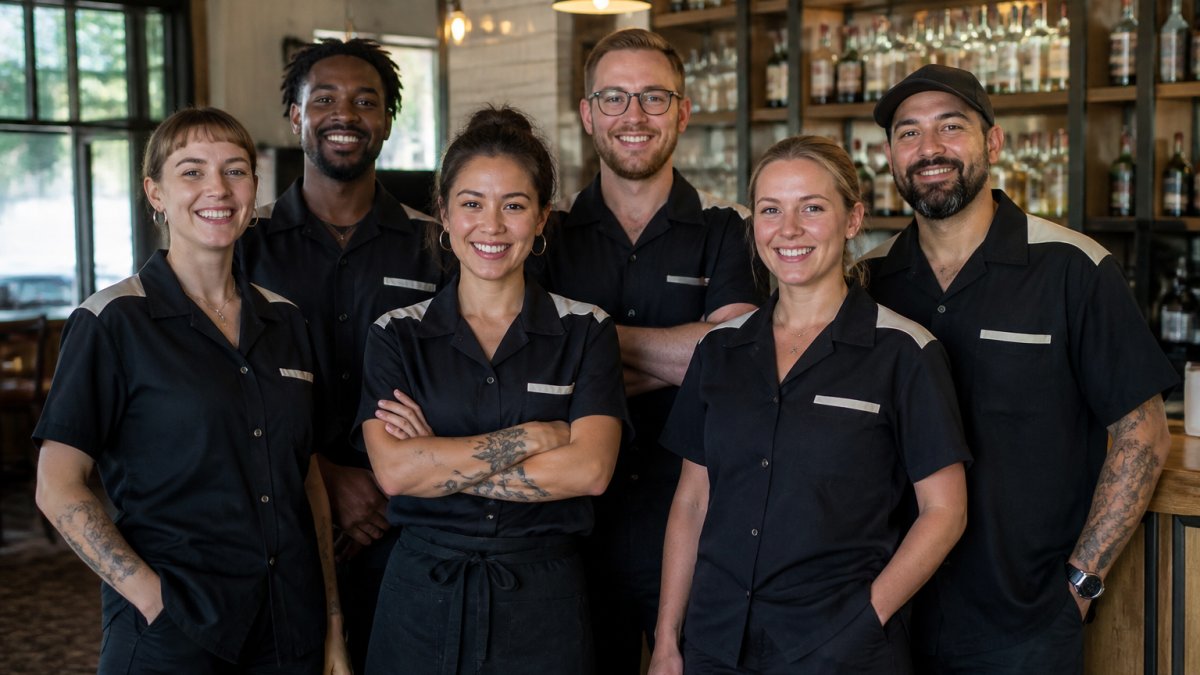
Embroidery delivers durability printing cannot match.
Brand visibility extends beyond your location. Staff wearing custom embroidered uniforms at events or community gatherings become mobile brand ambassadors, a bartender in a custom embroidered bowling shirt with your establishment's name is a moving advertisement.

The embroidered logo becomes part of your brand's story. Unlike temporary printed designs, embroidery signals permanence and quality, which translates into customer confidence and loyalty.
Staff Uniform Advantages and Disadvantages: What You Need to Know
Staff uniforms offer clear operational advantages: they eliminate daily dress-code decisions, reduce clothing-related distractions, and create a unified professional appearance. Employees frequently report feeling more confident and part of a cohesive team in matching branded apparel. But the honest case requires looking past the benefit list into the numbers, the fit, and the long-term care burden.
The real cost of ownership, not just the sticker price
A uniform program's true cost is four line items:
- One-time digitizing and setup. Converting your logo into an embroidery file is a one-time cost, commonly around $40 for a standard left-chest logo, though complex multi-color or multi-location logos run higher. It does not repeat when you reorder the same design.
- Per-garment cost. Embroidered work shirts typically land in the $30-$70 range depending on fabric, construction, and quantity. At Steady Clothing, double-panel and single-panel bowling shirt styles start at $49.99, with per-shirt pricing of $49.99-$57.99.
- Replacement cadence. This is where embroidery separates itself. A printed logo often fades, cracks, or peels within roughly 50-75 wash cycles; a well-embroidered logo commonly holds up through 300+ wash cycles. For staff laundering twice a week, that is the difference between replacing shirts every six to nine months versus every three-plus years.
- Maintenance and labor. Commercial laundering, stain treatment, and staff time managing uniform inventory are real costs. Machine-washable polyester, like the Poplin and PopCheck fabrics in Steady Clothing's shirts, keeps this low because it tolerates frequent washing without special handling.
Run the math on a 20-person team: twenty shirts at $50 each is $1,000, plus $40 setup, for $1,040 upfront, about $2 per shirt in setup. If embroidery extends replacement from roughly twice a year to once every three years, annualized garment cost drops from about $2,000 to roughly $350, before counting the marketing value of a logo that stays crisp.
| Advantage | Disadvantage |
|---|---|
| Professional, unified appearance | Upfront setup and garment investment |
| Strengthens brand recognition at every touchpoint | Sizing and fit challenges across diverse teams |
| Reduces daily dress decisions | Employee resistance if style or fabric doesn't suit the role |
| Creates team identity and cohesion | Ongoing laundering and inventory management |
| Embroidery holds up through 300+ wash cycles | Higher per-unit cost than basic screen printing |
| Logo stays crisp without reprinting | Limited design flexibility for photo-realistic artwork |
Fit, comfort, and role-specific needs
The most common reason uniform programs fail is not cost, it is fit. A uniform that runs small, restricts movement, or ignores body-type diversity creates resentment rather than pride.
- Offer at least two silhouettes. Steady Clothing's double-panel and single-panel bowling shirt designs accommodate different body types and style preferences, so staff choose the cut that fits them.
- Match fabric to the role. Fast-paced bar and restaurant floors need breathable, lightweight fabric that moves with the wearer; outdoor or event staff need durability against repeated wear and weather. Poplin is lightweight and comfortable; PopCheck adds texture and visual interest.
- Plan for climate and mobility. Kitchens, patios, and event setups have very different heat and movement demands. A single uniform spec rarely serves every role well.
Care and longevity: keeping embroidery looking new
Embroidery is durable, but not indestructible. A few habits extend its life:
- Wash inside out on a normal cycle with like colors to protect thread from abrasion against zippers and buttons.
- Skip the high-heat dryer. Tumble low or hang dry; high heat is the primary enemy of both fabric and backing.
- Avoid bleach and fabric softener. Bleach degrades thread color; softener leaves residue that dulls stitch definition.
- Trim loose threads, don't pull them. Pulling can unravel a stitch run.
- Inspect backing. Cut-away backing is standard for most uniform logos and holds up well; tear-away is lighter but less durable for frequently washed garments.
When uniforms are the wrong call
Choose the right garment and vendor for your operation. Allowing 3 to 5 business days for custom embroidery and specialty buttons ensures quality execution.
Embroidery vs. Printing for Uniforms: Durability and Cost Comparison
Embroidery and printing are fundamentally different approaches to putting your logo on staff uniforms.
Embroidery uses thread to create raised, dimensional designs; printing applies ink or plastisol directly onto fabric.
Printing works best for complex, photo-quality designs or full-color graphics; embroidery excels with logos, text, and solid-color designs.
Cost comparison depends on volume.
Embroidery also handles washing better. Printed designs can crack or peel in hot water or high-heat drying, while embroidered logos maintain their integrity regardless of care, which matters for commercial laundry services using industrial equipment.
Embroidered Work Shirts with Logo: Design, Placement, and Selection
Garment and placement strategy determine how effectively your custom embroidered work shirts represent your brand.
Logo placement matters more than most owners realize. Chest placement is standard, professional, visible during customer interactions, and photographs well.
Logo size requires balance: too small disappears and fails to build recognition, too large overwhelms the garment.
Thread color affects visibility and aesthetic. High-contrast thread (dark on light, light on dark) maximizes visibility; matching brand colors maintains consistency but may reduce contrast.
Garment selection shapes the uniform's appearance and function. Steady Clothing offers double-panel and single-panel bowling shirt styles in various color combinations: double-panel designs create bold impact with contrasting side panels, while single-panel offers cleaner, subtler aesthetics.

Consider your work environment. Fast-paced bars and restaurants need breathable fabrics that don't restrict movement; outdoor events and extended wear demand durable, weather-resistant materials.
Employee Morale, Team Cohesion, and Professional Behavior
Most uniform guides assert that branded apparel boosts morale and teamwork, then move on. This section covers the mechanism, the failure modes, and how to tell whether your program is actually working.
Why uniforms can shift behavior
- Enclothed cognition. Research in social psychology has found that what a person wears can influence their mental state and performance, clothing carries symbolic meaning the wearer internalizes (pubmed.ncbi.nlm.nih.gov). A uniform signals "I am at work, in a professional role," and staff carry themselves accordingly.
- In-group signaling. Visible shared markers, a matching shirt, a common logo, increase perceived group membership, showing up most during high-pressure shifts when cooperation matters most.
- Accountability cue. A branded uniform makes an employee identifiable to customers, which can nudge professional behavior because the person is no longer anonymous.
- Customer expectation setting. When customers instantly identify staff, interactions start faster and with less friction, reducing daily frustrations that erode morale on both sides of the counter.
The failure modes that kill the benefit
Uniforms can damage morale as easily as improve it. Common failure patterns:
- Poor fit. A shirt that is too tight, too short, or cut for one body type signals to employees that they were an afterthought. Fit is the single biggest driver of resentment.
- Uncomfortable fabric for the role. A heavy shirt in a hot kitchen or stiff fabric on a mobile floor team turns every shift into a small irritation.
- No input in selection. When staff have zero say in style or silhouette, the uniform reads as imposed rather than shared. Offering two or three approved options, like Steady Clothing's double-panel and single-panel bowling shirt cuts, restores choice without sacrificing consistency.
- Low-quality garments. Cheap construction that pills, fades, or loses shape within weeks teaches employees that the brand doesn't invest in them.
- Inconsistent enforcement. If some staff wear the uniform and others don't, the cohesion benefit evaporates and compliant employees feel penalized.
How to measure whether it's working
Employee-side metrics:
- Voluntary turnover rate in uniformed roles versus the prior period. A drop is the clearest signal of improved morale.
- Short anonymous pulse surveys (3-5 questions) on pride in appearance, comfort, and team belonging. Track the trend, not the absolute score.
- Uniform compliance rate, the percentage of shifts where staff wear the uniform correctly. High compliance usually correlates with acceptance.
- Sizing and replacement requests. A spike may signal fit problems; a drop may signal satisfaction.
Customer-side metrics:
- Customer satisfaction scores (post-visit surveys, review sentiment) before and after rollout.
- "Staff were easy to identify" or "service felt professional" as a tracked survey item, if you already run surveys.
- Compliment and complaint themes in reviews, mentions of professionalism or appearance are a soft but useful signal.
Financial metrics:
- Cost per wear. Divide total program cost by the number of shifts each shirt is worn. A $50 shirt worn twice a week for three years costs roughly $0.16 per wear.
- Replacement rate. Shirts replaced per year per employee. A low rate means the embroidery and fabric are holding up.
- Marketing value proxy. Estimate impressions by counting customer-facing shifts and public appearances where the logo is visible, then compare the implied cost per impression against paid advertising benchmarks.
Building buy-in from the start
The businesses with the strongest morale return involve staff early. A pre-order survey on preferred silhouettes, a fitting session before the bulk order, and a clear explanation of why the uniform exists (customer identification, brand consistency, professional presentation) all raise acceptance. When employees understand the purpose and control the fit, the uniform stops feeling like a costume and starts feeling like equipment, and people take pride in equipment.
Cost-Effective Marketing and Return on Investment
Custom embroidered staff uniforms are cost-effective marketing tools delivering ongoing brand exposure. Unlike advertising that requires continuous spending, uniforms create permanent, mobile brand presence.
Calculate the return by measuring brand exposure over time.
Uniforms reduce employee clothing expenses: when staff aren't buying their own work clothes, they save money, which becomes a retention benefit.
Brand consistency creates marketing efficiency.
For bars, restaurants, and event venues, branded uniforms become part of your identity.
The initial investment in embroidery setup and bulk garment orders pays dividends through reduced turnover, improved customer perception, and ongoing brand visibility.
Custom embroidered staff uniforms solve a fundamental business challenge: creating professional brand presence while building team identity and cohesion.
Frequently Asked Questions
What are the main advantages of custom embroidered staff uniforms?
Custom embroidered staff uniforms strengthen brand visibility, build employee pride, and create a consistent professional appearance. Embroidery is more durable than printing, lasting through hundreds of washes without fading or cracking. They also function as mobile advertising, making your brand visible wherever employees work or travel. For businesses like bars and restaurants, embroidered uniforms reinforce team identity and customer confidence in your operation.
Is embroidery better than printing for staff uniforms?
Embroidery outlasts printing significantly. While screen printing can fade or crack after 50-100 washes, quality embroidery remains vibrant for 200+ washes. Embroidery creates a textured, premium appearance that conveys professionalism and durability. Printing is cheaper upfront but requires replacement sooner, making embroidery more cost-effective over the uniform's lifetime. For staff uniforms that need to withstand frequent laundering, embroidery is the superior choice.
How do I choose the right embroidered work shirt with a logo for my business?
Start by selecting a garment that fits your team's needs and work environment. Consider fabric (100% polyester is durable and machine-washable), panel design (single or double panel affects comfort and appearance), and color combinations that match your brand. Logo placement matters: chest placement is standard for recognition, while back placement works for larger designs. Keep logos sized proportionally to the shirt. Work with your supplier on a proof before committing to bulk orders.
What should I consider before ordering embroidered uniforms in bulk?
Verify sizing options for your team. Confirm the embroidery setup charge and turnaround time (typically 3-5 business days for specialty buttons and embroidery). Request a proof for approval before full production. Understand care instructions to ensure longevity, 100% polyester garments are machine-washable and maintain embroidery quality. For groups of 20-30 shirts or more, ask whether custom button options are available to enhance the vintage aesthetic.